ADHD BAMF Proposal
Project Proposal: ADHD BAMF (Behavioral Adaptation and Management Framework)
Introduction
The ADHD BAMF (Behavioral Adaptation and Management Framework) is an innovative initiative designed to create a shared language and understanding between therapists, individuals with ADHD, and their support networks (family, friends, managers, etc.). Based on the MITRE ATT&CK Framework, this project aims to provide a comprehensive system to identify and manage ADHD behaviors through targeted mitigations and treatments.
Objectives
-
Create a Shared Language: Develop a framework that enables clear communication about ADHD behaviors and management strategies between individuals with ADHD, their therapists, and their support networks.
-
Identify and Categorize Behaviors: Systematically categorize expressions of ADHD across different areas of life (Zones) and identify specific behaviors (Expressions) that impact individuals.
-
Provide Targeted Mitigations: Offer a variety of skills, techniques, practices, and medical treatments (Mitigations) tailored to manage specific ADHD behaviors, allowing individuals to build a foundation for a healthy relationship with their neurodivergence.
-
Promote Accessibility: Ensure the framework is comprehensive and accessible to those who may not have the means to seek professional diagnosis and treatment.
The BAMF is split into 5 areas: Zones, Expressions, Mitigations, Detections, and Neurological Mechanisms. Objects in each area are assigned unique identifiers (e.g. EX0001) to help with version tracking as the framework changes over time.
Zones
Zones represent different areas of life where ADHD can have an impact. Examples of Zones might include:
- Academic and work performance
- Emotional regulation
- Social interaction and relationships
- Time management
Expressions
Expressions are specific behaviors or symptoms of ADHD that manifest within these Zones. While some of these may be backed by research, Expressions are often anecdotal and built form the experiences of people. Examples might include:
- Difficulty prioritizing tasks
- Doomscrolling
- Out of sight, out of mind
- Struggles with task initiation
Mitigations
Mitigations are strategies and treatments designed to manage these Expressions. They are not one-size-fits-all, and may have more or less impact on a person's life. They can include:
- Behavioral techniques (e.g., time management skills, organizational strategies)
- Cognitive techniques (e.g., mindfulness, cognitive behavioral therapy)
- Medical treatments (e.g., medication, supplements)
- Lifestyle adjustments (e.g., regular exercise, proper nutrition, adequate sleep)
Detections
Detections are methods and tools that help individuals recognize Expressions in their own behavior. Identifying these behaviors is crucial for understanding their impact and effectively implementing Mitigations. Detections can include:
- Keeping a journal
- Seeking feedback from others
- Reflection and mindfulness
- Behavioral observations
Neurobiological Mechanisms
Neurobiological Mechanisms refer to the physical, neurological, and scientifically-researched processes that contribute to ADHD behaviors. These mechanisms provide a foundation for understanding why certain behaviors occur and can guide the development of effective Mitigations. Key aspects of Neurobiological Mechanisms include:
- Neurotransmitter imbalance
- Brain structure variations
- Functional connectivity
- Cognitive dysfunction
Examples of Use
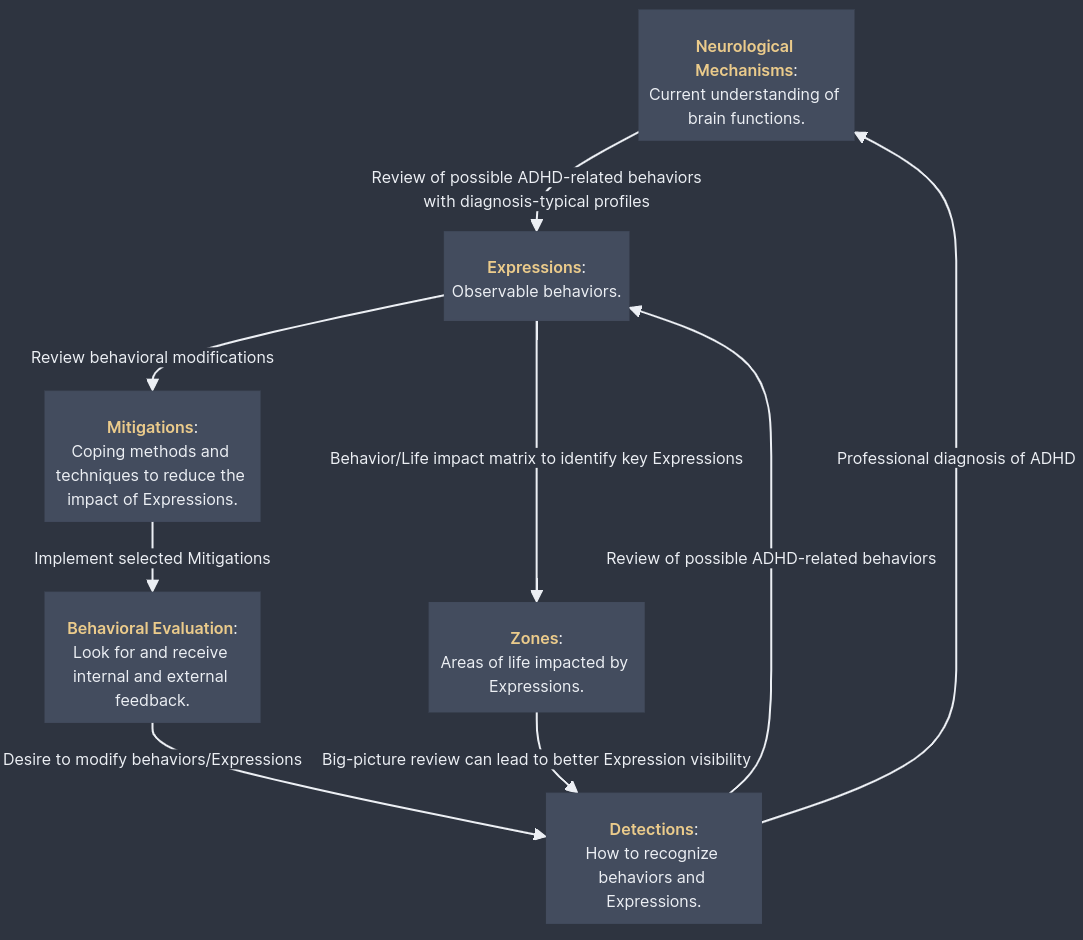
Flowchart
This flowchart explains how the ADHD BAMF might be used, and demonstrates the cyclical nature of recognition, motivation for change, and experimentation.
While this flow chart is a cycle and there is no "official" starting point, a common place to start is "Behavioral Evaluation" at the lower left.
MITRE ATT&CK Framework
The MITRE ATT&CK Framework is use by cybersecurity experts to identify common techniques adversarial hackers may use to gain access to a target system. It lays out the Tactics (objects) of the attacker, the specific Techniques they are likely to use, and Detections and Mitigations defenders can use to protect their systems.
In the ADHD BAMF framework, Tactics would be replaced with Zones and Techniques would be replaced with Expressions.

The MITRE ATT&CK framework.


Clicking on a Technique (like Content Injection) provides you with background on the technique, adversaries who are known to use it, and ways to Detect and Mitigate in your system.)

As demonstrated in the MITRE ATT&CK Navigator app,[2] the same Techniques (highlighted in blue) can be used to accomplish different Tactics across the framework.
The current list of Expressions and Mitigations can be found in the Proto-List of Expressions and the Proto-List of Mitigations, respectively.
If you would like to contribute or share your experience, please use this Google Form.
Implementation Plan
The implementation plan is all very loose and subject to change; some things will occur before others, and this is fine.
Phase 1: Initial Development
- Literature Review: Conduct a thorough review of existing research on ADHD, focusing on behavioral expressions and effective management strategies.
- Expert Consultation: Engage with ADHD specialists, therapists, and individuals with ADHD to gather insights and validate the framework's structure and content.
- Build Expressions and Mitigations List: Develop a comprehensive list of ADHD Expressions (observable behaviors) and corresponding Mitigations (strategies and treatments) to create a minimum viable product (MVP).
- Community Feedback: Open the framework for community feedback to ensure it is user-friendly and addresses real-world needs.
Phase 2: Expansion and Refinement
- Add Zones: Incorporate different Zones (areas of life) impacted by ADHD Expressions to provide a more holistic view of the framework.
- Include Detections: Develop methods for recognizing ADHD Expressions in daily life to help individuals identify and understand their behaviors.
- Integrate Neurobiological Mechanisms: Add detailed descriptions of the neurobiological mechanisms that underlie ADHD behaviors to provide a scientific basis for the framework.
- Collect Feedback: Gather feedback from pilot participants to identify strengths, weaknesses, and areas for improvement.
- Refine Framework: Make necessary adjustments to the framework based on pilot feedback.
Phase 3: Website Development and Accessibility
- Website Redesign: Rebuild the website to make it more accessible and user-friendly.
- Resource Integration: Integrate interactive tools, resources, and guidelines to help users navigate and implement the framework effectively.
- Educational Materials: Develop comprehensive educational materials, including guides, videos, and workshops, to help users understand and apply the framework.
- Community Engagement: Foster a community of practice through forums, social media, and regular updates to encourage continuous learning and sharing of best practices.
Phase 4: Evaluation and Continuous Improvement
- Ongoing Evaluation: Continuously monitor the effectiveness of the framework through user feedback, surveys, and performance metrics.
- Iterative Improvement: Regularly update the framework to incorporate new research findings, user feedback, and emerging best practices.
- Partnerships: Establish partnerships with ADHD organizations, educational institutions, and healthcare providers to expand the reach and impact of the framework.
- Sustainability: Develop a sustainability plan to ensure the ongoing development and maintenance of the ADHD BAMF framework.
Expected Outcomes
- Improved Communication: Enhanced understanding and communication about ADHD between individuals with ADHD, their therapists, and support networks.
- Effective Management: Increased ability for individuals with ADHD to manage their behaviors through targeted mitigations.
- Accessibility: Greater access to ADHD management strategies for individuals who may not have access to professional diagnosis and treatment.
- Empowerment: Empower individuals with ADHD to build a healthy relationship with their neurodivergence and improve their quality of life.
Conclusion
The ADHD BAMF represents a significant step forward in the management and understanding of ADHD. By leveraging the structure of the MITRE ATT&CK Framework, this project aims to provide a systematic and accessible approach to identifying and managing ADHD behaviors. Through collaboration, research, and continuous improvement, the ADHD BAMF will empower individuals with ADHD and their support networks to navigate the challenges of ADHD more effectively.
I've joked with a friend that Neurodivergence should be shortened to "NeurDi," and then I could call you "My NeurDi Fellows," but that was too much to explain for a short greeting, so instead I've made it a footnote that you've no-doubt clicked on and has been more distracting than if I had just used "NeurDi" in the greeting. ↩︎
To reach the same page as the screenshot, select "Create New Layer" followed by "Enterprise ATT&CK" ↩︎