About ADHD BAMF
Want to help?
If you are a looking for ways to contribute, please check check our ADHD BAMF Proposal[1] and the Community Input Google Form to share your experience or offer to help.
What is ADHD BAMF?
The ADHD BAMF (Behavioral Adaptation and Management Framework) is an initiative to create a shared language and understanding between therapists, individuals with ADHD, and their support networks (family, friends, managers, etc.). Based on the MITRE ATT&CK Framework, this project aims to provide a comprehensive system to identify and manage ADHD behaviors through targeted mitigations and treatments.
Objectives
Our goal is to empower individuals to build a foundation of tools and techniques for a healthy relationship with their neurodivergence.
-
Create a Shared Language: Develop a framework that enables clear communication about ADHD behaviors and management strategies between individuals with ADHD, their therapists, and their support networks.
-
Identify and Categorize Behaviors: Systematically categorize expressions of ADHD across different areas of life (Zones) and identify specific behaviors (Expressions) that impact individuals.
-
Provide Targeted Mitigations: Offer a variety of skills, techniques, practices, and medical treatments (Mitigations) tailored to manage specific ADHD behaviors, allowing individuals to build a foundation for a healthy relationship with their neurodivergence.
-
Promote Accessibility: Ensure the framework is comprehensive and accessible to those who may not have the means to seek professional diagnosis and treatment.
The Flow of Life with ADHD
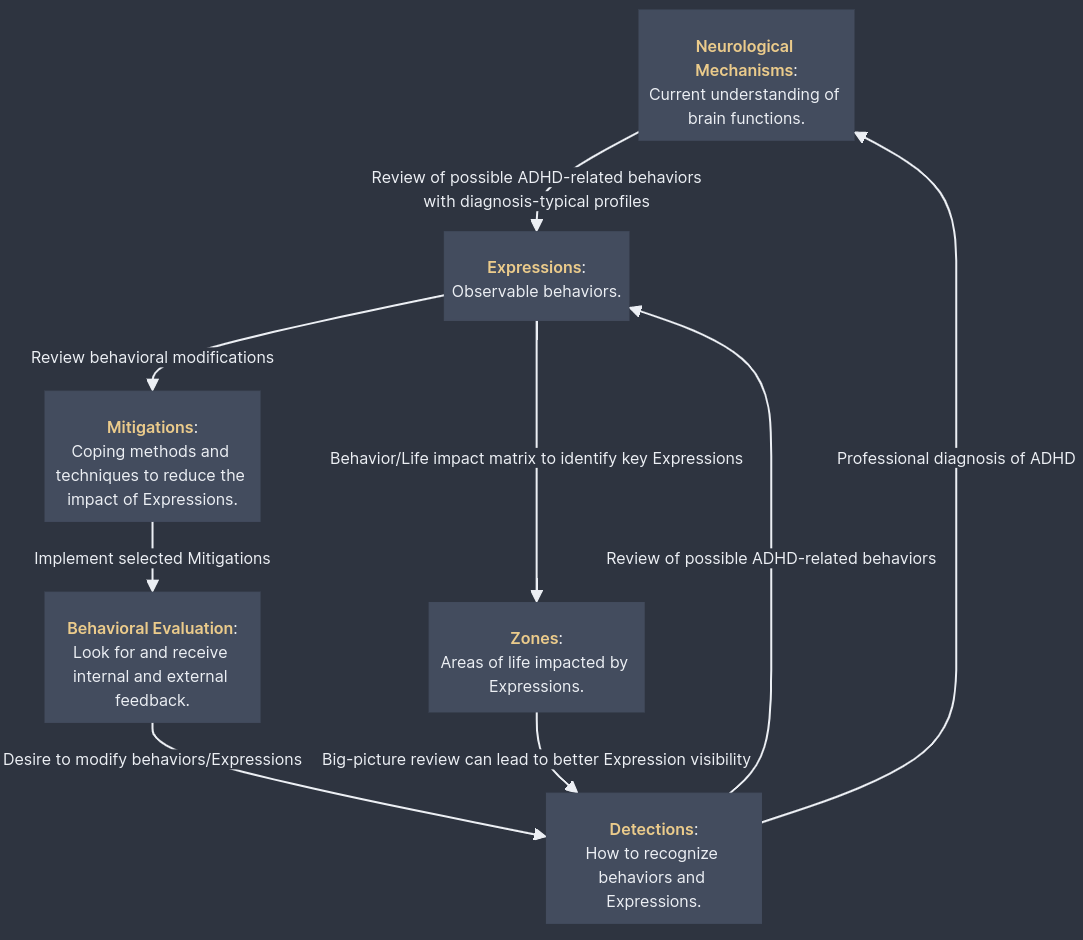
This flowchart explains how the ADHD BAMF might be used and demonstrates the cyclical nature of recognition, motivation for change, and experimentation.
While this flow chart is a cycle and there is no "official" starting point, a common place to start is Behavioral Evaluation at the lower left.
ADHD is not a disease with a "cure."
Before using this framework, I strongly encourage you to watch Jessica McCabe's video on internalized ableism.
My Channel was a Bit Ableist When I Started - YouTube
The goal of this framework is not to force people into a neurotypical pigeonhole or to encourage ideas like "if I can just do this one thing I'll be normal."
Our full statement on ableism.
ADHD is baked into the structure and function of the brain and is a core part of who we are. ADHD behaviors are not inherently good or bad, and can have positive or negative impacts depending on the circumstance.
The goal of this framework is to help identify patterns of behavior (Expressions) and empower people with skills, techniques, practices, and possible medical treatments (Mitigations) to help them manage their experience.
The framework is informative, not prescriptive. Due to the nature of ADHD, you may never find perfect equilibrium, and may have to try different combinations of mitigations to find something that works for you.
ADHD BAMF is NOT a Diagnostic Tool
ADHD BAMF is a behaviors-first framework, which may lead some to use it for self-diagnosis. However, behaviors often associated with ADHD are also common in Depression, Anxiety, ASD (Autism Spectrum Disorder), and other conditions[2]. Identifying with an Expression or finding a Mitigation helpful does not mean you have ADHD.
Seek Professional Diagnosis: If you suspect you have ADHD, it's important to seek a professional diagnosis or assessment and treatment. ADHD shares expressions with many other disorders, and professional diagnosis can be critical in finding effective treatment. Official recognition can also help you get accommodations at school or work, reveal comorbidities, and better enable you to address your specific challenges.
Accessibility Concerns: Diagnosis may be expensive or not easily available in some areas. We do not believe this should be a barrier to care and treatment, and want the Framework to be as accessible as possible, and we hope the tools are broad enough to be helpful in any situation.
Curious what the note icon here means? Check out our page on Note Icons. ↩︎
Misdiagnosed ADHD: See Shared Symptoms with other Disorders ↩︎